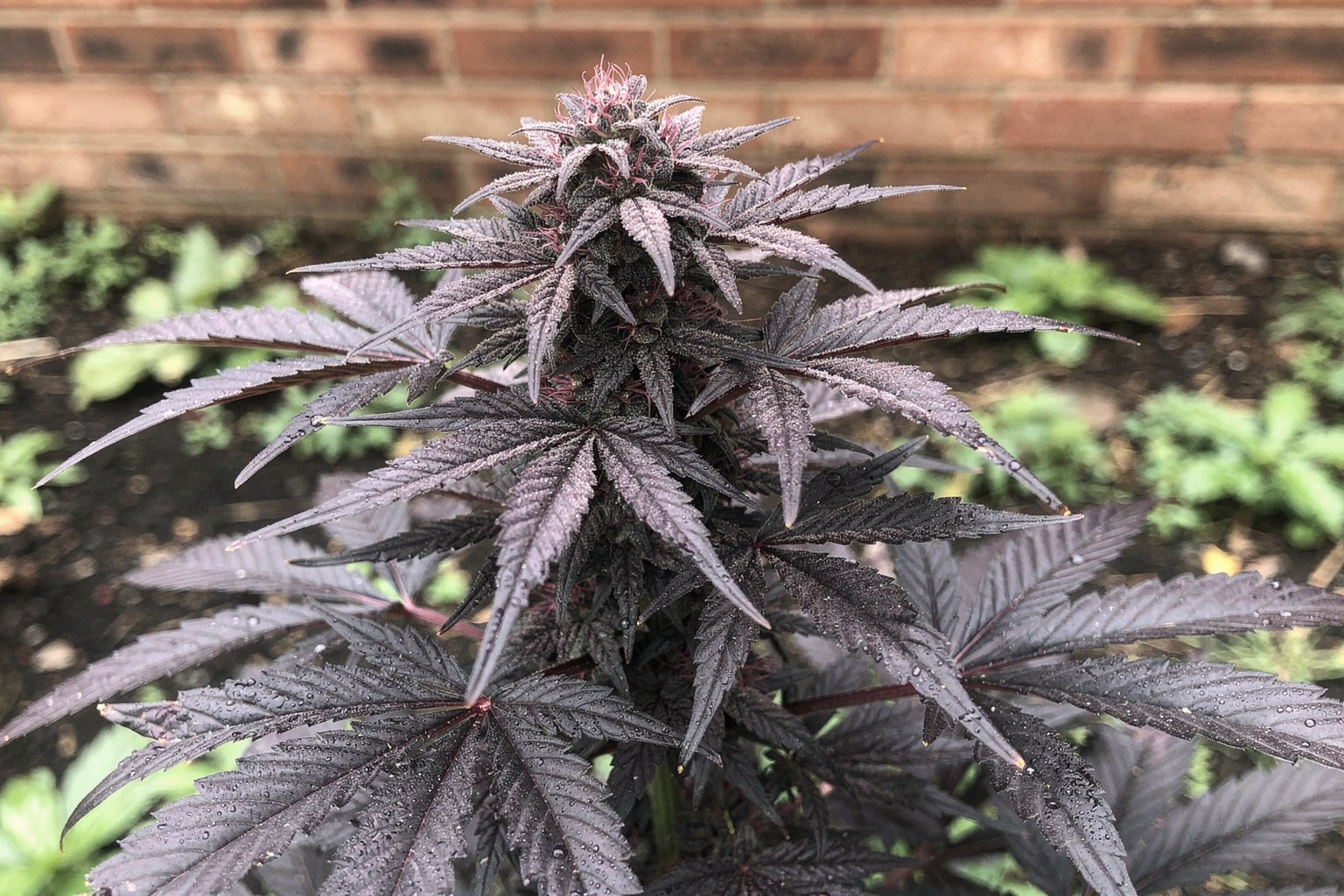
Notable purple cannabis varieties in our collection include Purple Kush, Purple Haze and Granddaddy Purple, the grape-scented Grape Ape, Purple Urkle and Gumbo, and modern crosses such as Purple Gelato, Cherry Pie, Pinkman Goo and London Pound Cake. Their colour comes from anthocyanins, the same pigments that make blackberries and red cabbage purple. Whether a plant shows that colour depends partly on genetics and partly on conditions, especially cool night temperatures late in the season, which is why purple tones are often discussed in connection with Britain's cool autumns.
By the Seedsmaster editorial team.
Key takeaways
- Purple is a pigment: Anthocyanins produce purple, red and blue shades in leaves and flowers.
- Genes set the potential: Only some varieties carry the capacity to produce strong purple colour.
- Cool nights reveal it: Lower temperatures late in the season often bring purple tones to the surface.
- Purple lines have history: Many trace back to Afghan, Thai and Californian sources.
- Colour is not potency: Purple shades say nothing about cannabinoid content.
Why some cannabis turns purple
Green is the default colour of a cannabis plant because chlorophyll dominates its leaves. Other pigments are present too, but usually hidden. As the season changes, and as a plant matures, chlorophyll production slows. Pigments that were masked can then become visible, in the same way that some garden plants and trees turn red or purple in autumn.
In cannabis, the main purple pigments are anthocyanins. These are water-soluble compounds stored in cell vacuoles, and their colour shifts with acidity: they can appear red, purple or blue depending on conditions inside the cell. Anthocyanins are widespread in the plant world, from blueberries and aubergines to red cabbage, and botanists associate them with roles such as shielding tissue from strong light and responding to cold stress.
Genetics, cold nights and the role of anthocyanins
Whether a cannabis plant turns purple depends first on its genes. Some varieties carry a strong capacity to produce anthocyanins; others rarely show any colour at all. For varieties with that capacity, environmental conditions often decide how strongly the colour appears.
The best-known trigger is temperature. Cooler night temperatures, particularly in the final weeks of the season, slow chlorophyll production and can increase anthocyanin accumulation. This is why purple shades are often most dramatic in autumn and why the same variety may look greener in a warm climate and darker in a cool one.
Not all purple colouring is a matter of genetics and temperature. Botanists also note that discolouration can accompany nutrient imbalances, particularly phosphorus shortage, or damage from cold. Those cases usually look different: the colour appears on stems and older leaves rather than evenly across buds and sugar leaves. In descriptive terms, genetic purple tends to be uniform and attractive, while stress-related colour is patchy.
The purple lines and where they came from
Several historical sources fed the purple varieties known today. Afghan and Hindu Kush landraces carried dark pigmentation in some selections, and the variety known as Purple Afghani contributed to Purple Kush. From Southeast Asia, Purple Thai entered breeding programmes and appears in the lineage of Purple Haze. In northern California, a line known as Mendocino Purps became the basis for many later purple varieties, including Purple Urkle and, through it, Granddaddy Purple.
Purple cannabis was long something of a curiosity. In the 1970s and 1980s, coloured plants were often described in growers' magazines as a by-product of cold mountain nights rather than a breeding goal. That changed as seed companies began selecting deliberately for colour, partly because purple flowers photograph well and stand out in catalogues. By the 2000s, purple had become a recognised category of its own, with dozens of varieties marketed largely on their colour and fruity aroma.
From these sources, breeders produced a wide range of purple hybrids. Some emphasise grape and berry aromas, others combine purple colour with the dessert-style profiles popular in recent years. Seed catalogues describe them in terms of genetics, aroma, flowering time and size, and those catalogue descriptions are the basis for the list below.
Purple classics: Purple Kush, Purple Haze and Granddaddy Purple
1. Purple Kush
Purple Kush combines Hindu Kush with Purple Afghani. Our catalogue lists it as fully indica, with a THC range of 17 to 27 percent, a flowering time of seven to eight weeks and an outdoor height of up to 110 cm. Its aroma is described as earthy, sweet, fruity and grape-like.
2. Purple Haze
Purple Haze brings together Haze and Purple Thai. It is listed at 15 to 20 percent THC, with nine to ten weeks of flowering and a height of up to 225 cm. Its name also echoes a famous 1967 song, which helped make it one of the most recognisable variety names of its era. The catalogue describes a spicy, sweet, incense-like aroma.
3. Granddaddy Purple
Granddaddy Purple is a cross of Purple Urkle and Big Bud. It is listed at 17 to 23 percent THC, with nine to ten weeks of flowering and a height of up to 180 cm. Its aroma combines berry, grape and sweetness with earthy and pine notes. It is the parent of several newer purple varieties.
Grape-scented varieties: Grape Ape, Purple Urkle and Gumbo
4. Grape Ape
Grape Ape is commonly reported as Mendocino Purps crossed with Skunk and Afghani. The catalogue lists 18 to 25 percent THC and a short flowering time of six to eight weeks, with a height of up to 150 cm. Its aroma is described as grape, berry and sweet, with spice and skunk.
5. Purple Urkle
Purple Urkle is likely of Mendocino Purps lineage, though its exact parentage is uncertain. It is listed at 18 to 20 percent THC, with seven to eight weeks of flowering and a height of up to 180 cm. Its aroma is berry-led, with earthy and skunky notes.
6. Gumbo
Gumbo is reported as Bubblegum crossed with Hindu Kush. The catalogue lists 15 to 20 percent THC, eight to nine weeks of flowering and a height of up to 220 cm, with a sweet, fruity, candy-like aroma that includes grape and berry.
Modern purple crosses and a London name
7. Purple Gelato
Purple Gelato combines Purple Haze and Gelato. It is listed at 18 to 22 percent THC, eight to ten weeks of flowering and a height of up to 210 cm, with a complex aroma of berry, citrus, mint and lime.
8. Cherry Pie
Cherry Pie crosses Granddaddy Purple with Durban Poison. It is listed at 16 to 24 percent THC, with nine to ten weeks of flowering and a height of 150 to 200 cm. Cherry, berry and sweetness lead its aroma.
9. Pinkman Goo
Pinkman Goo is a Granddaddy Purple, Grape Ape and Northern Lights #5 cross, listed at 15 to 18 percent THC, eight to eleven weeks of flowering and a height of up to 180 cm, with berry and coffee notes.
10. London Pound Cake
London Pound Cake descends from Sunset Sherbet and an unidentified indica-leaning parent. Despite its name, the variety was developed in California, but the reference to London gives it a place in British cannabis conversation, much like Cheese. The catalogue lists 20 to 26 percent THC, nine to ten weeks of flowering and a height of up to 200 cm, with berry, grape, vanilla and cookie notes.
Purple colour in a British context
Britain's climate is often mentioned in discussions of purple cannabis because its autumns combine cooling nights with relatively mild days. As described in our article on autumn weather and seasonal change, temperatures in September and October fall steadily, and the difference between day and night widens on clear evenings. Those are exactly the conditions botanists associate with stronger anthocyanin expression in many plants, from ornamental shrubs to red-leaved vegetables.
The same autumns, however, are also damp, and dense purple flowers are no different from green ones in their susceptibility to moisture. Colour is an aesthetic and botanical feature, not a sign of robustness or potency. Seed catalogues, including ours, list cannabinoid ranges separately from colour, and a purple variety may have lower or higher listed THC than a green one.
Interest in purple varieties also reflects a broader fascination with plant colour in British horticulture. Gardeners have long prized purple-leaved forms of familiar plants, from copper beech and purple sage to dark-leaved heucheras, and the same pigments are involved. In each case, the colour is a visible expression of chemistry inside the leaf, shaped by inheritance and by the conditions a plant experiences through the year.
Purple varieties are sold in the same seed categories as others, as feminised, regular or autoflowering seeds. Our guide to feminised, autoflower and regular seeds explains what those labels mean for collectors.