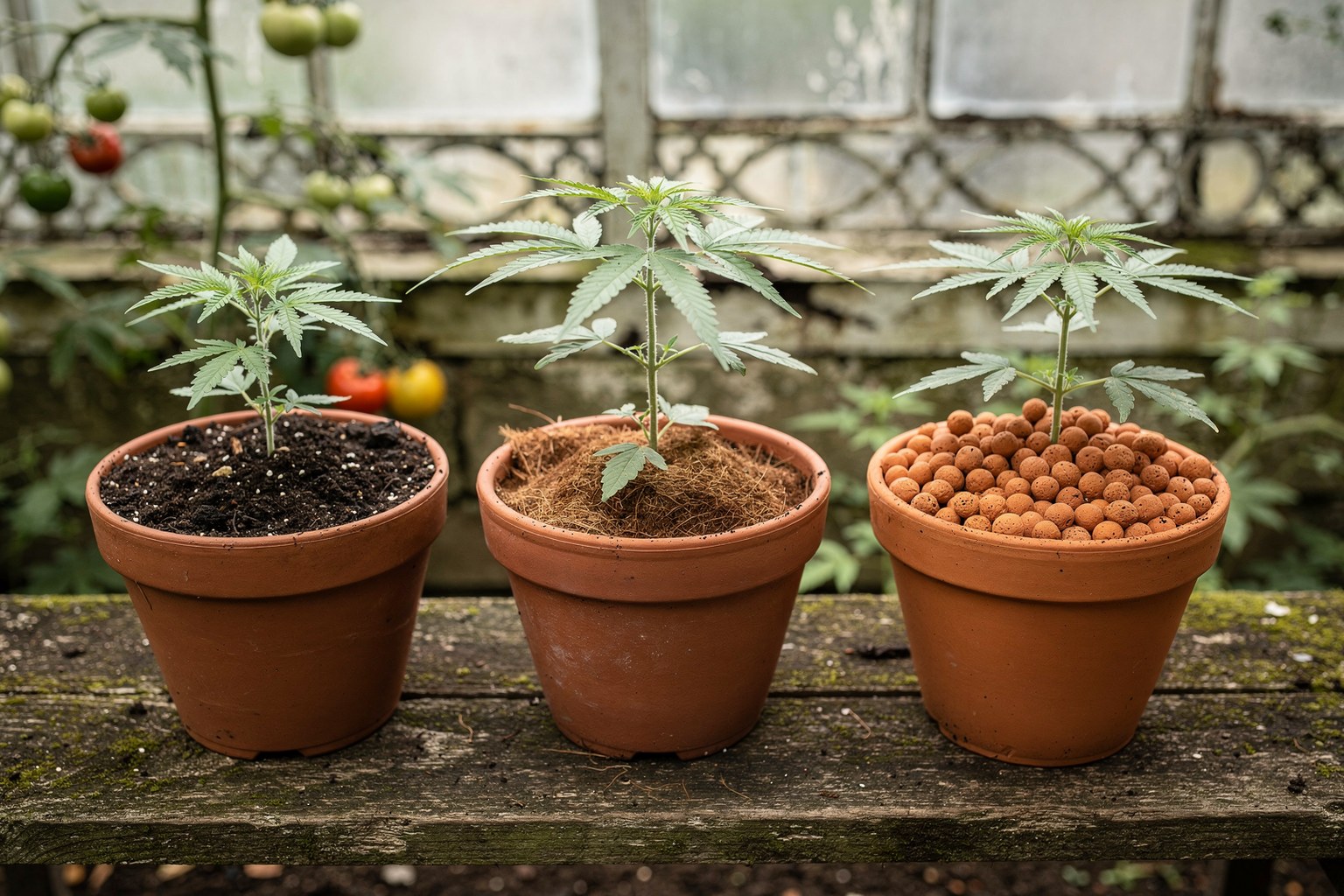
Soil, coco coir and hydroponic media are three different ways of supporting plant roots. Soil and compost are living materials that store water and nutrients and buffer change. Coco coir is a fibrous, soilless material that holds moisture while staying airy. Hydroponic media such as clay pebbles and rockwool are inert, so the plant depends entirely on a nutrient solution. Each has a long history in horticulture, and each behaves differently in Britain’s cool, damp climate.
By the Seedsmaster editorial team.
Key takeaways
- Media differ in buffering: Soil absorbs and releases nutrients gradually, while inert hydroponic media hold almost none.
- Air space matters: Roots need oxygen as well as water, and media vary greatly in how much air they hold.
- Coco has replaced much peat: Concern for peatland habitats has driven interest in coir and other alternatives.
- Hydroponics is mainstream horticulture: Many glasshouse vegetables in Europe are grown in soilless systems.
- Climate shapes behaviour: Cool, humid British conditions slow drying and influence how each medium performs.
What horticulturists mean by a growing medium
A growing medium is any material in which plant roots grow. In the open garden, that material is simply soil. In containers, glasshouses and commercial horticulture, it is often a prepared mixture designed for particular properties. The Royal Horticultural Society and commercial growers describe media in terms of a few key characteristics: how much water they hold, how much air remains in the pores when they are wet, how they change over time and how strongly they buffer nutrients and acidity.
These properties matter for every container plant, from tomatoes and bedding plants to houseplants and, in a botanical sense, cannabis. They explain why a pot of heavy garden soil behaves very differently from a bag of multipurpose compost, and why commercial glasshouses often use materials that look nothing like soil at all.
Soil and compost as living materials
Garden soil is a complex mixture of mineral particles, organic matter, water, air and an enormous community of living organisms. Fungi, bacteria, earthworms and countless smaller creatures break down organic matter and release nutrients slowly over time. This biological activity is one reason soil is so forgiving: it stores nutrients and releases them gradually, smoothing out sudden changes.
Composts for containers
Garden soil on its own often performs poorly in pots because it compacts and drains badly in a confined space. Container composts were developed to solve this problem. The John Innes formulas, devised at the John Innes Horticultural Institution in the 1930s, combine loam, peat or a substitute and grit or sand in fixed proportions. They remain widely sold in Britain and are valued for their weight, stability and nutrient-holding capacity.
Multipurpose composts, by contrast, are lighter and usually based on peat or peat alternatives such as composted bark, wood fibre and coir. They hold plenty of moisture and suit a wide range of container plants.
Living soil approaches
Some gardeners favour so-called living soil, rich in compost and worm castings, where the biological community plays the main role in supplying nutrients. The idea draws on organic gardening traditions that have a strong following in Britain, from the Henry Doubleday Research Association, now Garden Organic, to the no-dig movement popularised by contemporary gardeners.
Coco coir and the move away from peat
Coco coir is made from the fibrous husks of coconuts, a by-product of the coconut industry in countries such as Sri Lanka and India. Once regarded as waste, coir became a widely traded horticultural material as gardeners and growers looked for alternatives to peat.
Why peat alternatives matter
Peat forms over thousands of years in bogs and stores large amounts of carbon. Extracting it damages these habitats and releases carbon. For this reason, there has been sustained pressure in Britain to reduce peat use in gardening, and many retailers now offer peat-free composts based on bark, wood fibre, green waste and coir.
How coir behaves
Coir holds water well but remains airy even when wet, because its fibres resist compaction. It contains very few nutrients of its own, so plants growing in coir rely on nutrients supplied with water. Coir also tends to hold on to calcium and magnesium, which horticultural suppliers address with specially balanced feeds. In botanical terms, coir sits between soil and fully inert media: it offers some structure and moisture buffering but little nutrient supply.
Hydroponic media and soilless culture
Hydroponics, or soilless culture, grows plants with their roots in an inert material or directly in water, supplying all nutrients in solution. Although it can sound futuristic, the principle has been studied for well over a century, and soilless systems now underpin much of Europe’s glasshouse vegetable production. Tomatoes, cucumbers, peppers and salad leaves sold in British supermarkets are frequently grown this way, both in Britain and in the Netherlands.
Common hydroponic media
- Rockwool: made by melting rock and spinning it into fibres, then pressing them into slabs and cubes. It holds water and air in a stable structure and is widely used in commercial glasshouses.
- Expanded clay pebbles: small fired clay balls that are light, porous and reusable. They are familiar from houseplant hydroculture.
- Perlite and vermiculite: volcanic minerals expanded by heat, often used in mixes to add air space or water retention.
Because these media are inert, they provide no buffer. The composition and acidity of the nutrient solution directly determine what the plant receives. This gives commercial growers precise control, but it also means that changes in the solution affect plants very quickly.
A brief history of soilless growing
The idea of growing plants without soil is older than it might seem. In the seventeenth century, the Flemish scientist Jan Baptist van Helmont grew a willow in a measured pot of soil and noted that the soil lost very little weight while the tree gained a great deal, an early hint that plants draw on more than soil alone. Later botanists, including the British naturalist John Woodward, experimented with growing plants in different kinds of water in the 1690s.
In the nineteenth century, German plant physiologists developed nutrient solutions that allowed plants to grow with their roots in water alone, establishing which mineral elements are essential. The term hydroponics was popularised in the 1930s in California, where researchers demonstrated large tomato plants grown in nutrient tanks. During the Second World War, soilless systems supplied fresh vegetables to troops on islands with little usable soil.
In the decades that followed, glasshouse growers in the Netherlands, Denmark and Britain adopted rockwool and other soilless systems on a large scale, attracted by cleanliness, consistency and the ability to recycle nutrient solutions. Today, these methods are an ordinary part of commercial horticulture rather than a specialist curiosity.
Houseplant hydroculture
Many British households have encountered soilless growing without realising it. Office and houseplants sold in clay pebbles with a water-level indicator use the same principle of an inert medium and a reservoir of nutrient solution, adapted for low-maintenance indoor display.
Buffering, water holding and air space compared
Comparing the three approaches side by side makes their differences clear.
- Buffering: Soil and compost buffer strongly, coir moderately and inert media hardly at all.
- Water holding: Compost and coir hold a great deal of water; clay pebbles very little, rockwool a moderate amount in a stable structure.
- Air space: Coir and clay pebbles remain airy when wet, while dense soils can become waterlogged in containers.
- Nutrient supply: Soil and compost supply nutrients themselves; coir and inert media depend on added nutrients.
- Change over time: Organic materials decompose and settle; inert media remain largely stable.
These differences explain why horticulture uses all three. Soil and compost suit gardens and mixed plantings where resilience matters. Coir suits container growing where structure and moisture balance are priorities. Hydroponic media suit controlled environments where precision and consistency are the goals.
Growing media in British horticulture and climate
Britain’s climate is cool and frequently humid, as our overview of UK climate regions and seasons explains. In such conditions, water evaporates slowly from containers, and media that hold a lot of moisture stay wet for longer. Gardeners in the wetter west and north often favour open, free-draining mixes for container plants, while those in the drier south-east may value the water-holding capacity of richer composts.
Humidity also influences what happens above the medium. Damp air and condensation around plants are common in British autumns, and our article on humidity, dew point and condensation describes why still, cool nights are significant for foliage and flowers.
Indoor environments
Indoors, heating and ventilation change the picture again. Centrally heated rooms in winter are often drier than outdoor air, which speeds drying in containers. Our feature on indoor growing culture, climate and seed terms places these indoor conditions in a broader British context.
Regional notes
For collectors and readers interested in cannabis as a plant, understanding growing media helps make sense of the terms used in seed catalogues and horticultural writing. Descriptions that mention vigour, root development or suitability for particular conditions often assume a specific medium. Our guide to feminised, autoflower and regular seeds explains the seed terminology that frequently accompanies such descriptions, completing the botanical picture.